
Accessible Support For
Sensitive Dog Guardians
✨ THE MEMBERSHIP ✨
Caring for a sensitive or complex dog can feel overwhelming, but you don’t have to figure it out alone.
The Transform Behavior Membership is low cost, ever-growing educational hub and community designed for big feeling dogs and their people.
What You Get:
Access to the online membership space
Twice monthly live events (zoom)
Over 50 hours of courses and webinars
A group forum where you can ask questions
Direct access to ask Karishma Warr
Advice and support from a community of 100 dog guardians who get it
Start learning for free

Let’s talk about how we may communicate 'I cannot allow you to do that' in ways that are net positive for the dog, and the relationship
Let’s talk about how we may communicate 'I cannot allow you to do that' in ways that are net positive for the dog, and the relationship
3 Key Principles that underlying this discussion:
1. A holistic foundation comes first: health, exposure to stress/ challenge, fulfilment, and a secure relationship
2. Use this communication carefully: saying 'no' is never a solution to a dog seeking safety
3. When teaching ‘no’ we never hurt of scare the dog: we use functional, fair, miminaly aversive consequences

Live reading of my new blog Managing Heera’s Pain
In this article I’ll take you through my personal experience accessing care for my painful dog, and share the conclusions I’ve come to after a decade of training ‘difficult’ (AKA painful) dogs.
.
.
.
Want to learn more or ask specific questions?
I invite you to join my membership for £15/$19 per month, where you will find more content, access to me, and a community of knowledgable and supportive guardians


This video is for those who think their dog may be sick, or in pain, and are struggling to get taken seriously by medical professionals.
It goes into WHY it can be so tough to get chronic conditions diagnosed, and gives some tips about navigating the medical system and getting your dog the care they deserve
.
.
.
Want to learn more or ask specific questions?
I invite you to join my membership for £15/$19 per month, where you will find more content, access to me, and a community of knowledgable and supportive guardians


Today I’m going to chat through why I think freedom of movement in natural spaces is so important for dogs
And why it’s equally important to offer realistic harm reduction strategies for those who need it
I finish with the most important point of all, so stick around until the end
.
.
.
Want to learn more or ask specific questions?
I invite you to join my membership for £15/$19 per month, where you will find more content, access to me, and a community of knowledgable and supportive guardians

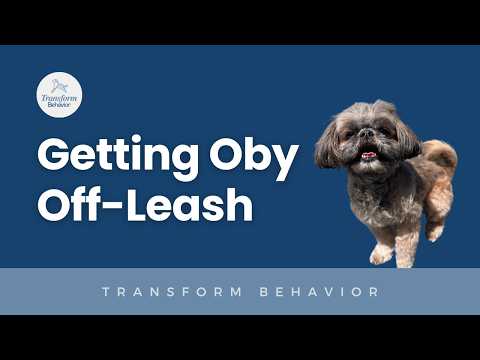
In this video I'll break down the last 2 months of work I've done to get my shih tzu, Oby, off-leash safely
Check out my insta for more content showing the process www.instagram.com/transformbehavior/
.
.
.
Want to learn more or ask specific questions?
I invite you to join my membership for £15/$19 per month, where you will find more content, access to me, and a community of knowledgable and supportive guardians

In this live, I’m joined by my bestie and hot-shot dog behaviour consultant Lauren Tapp from Catalyst Canines to talk about the relationship between gut health and behaviour in sensitive dogs.
We explore why GI health is about much more than obvious symptoms like vomiting and diarrhoea, and how subtle or ongoing gut issues can show up through changes in a dog’s behaviour, appetite, sleep, sensitivity and overall wellbeing.
We also talk about how guardians can start noticing patterns without becoming overwhelmed, and why improving gut health is rarely about finding one food, supplement or intervention that fixes everything.
Topics Covered:
The connection between GI health, stress, emotions and behaviour
Subtle and behavioural signs that may indicate GI discomfort
Why common symptoms like intermittent loose stool, vomiting and picky eating shouldn’t automatically be considered normal
How to observe and track your dog’s symptoms so you can identify patterns and communicate more effectively with your veterinary team
Why we recommend slowing down rather than changing your dog’s food, supplements and routine all at once
How stress, sleep, fulfilment, feeding environments and eating rituals can interact with gut health
The relationship between food, training and behaviour, particularly for dogs who already have a difficult or conflicted relationship with eating
Why complex GI cases often require us to look at the whole dog rather than searching for one simple solution
This conversation is intended as an accessible starting point for guardians of sensitive dogs who want to better understand how their dog’s physical health and behaviour may be connected.
📍To work with Lauren, or learn more about her coaching service at @catalyst_canines | www.catalystcanines.com
📍To see more content like this, or ask me (Karishma) specific questions, join my membership www. transformbehavior.com/membership
.
.
.
📍To work with Lauren, or learn more about her coaching service:
www.catalystcanines.com
📍To see more content like this, or ask me (Karishma) specific questions, join my membership:
www. transformbehavior.com/membership
What happens when we stop obsessing over consequences and conditioning?
Is there a way to communicate with dogs other than “training them”?
This is the first of many more videos about what happens when we think beyond dog training and behaviourism…
and shine a light on the natural ways humans and dogs have communicated for thousands of years
For me, it’s opened up a whole new world of connection and authenticity
I hope you enjoy x
.
.
.
Update: my membership and coaching services are at capacity until the new year. sign up for my newsletter to be the first to hear when they open.